
A painful or infected tooth rarely waits for a convenient time to act up. If your dentist has mentioned a root canal or extraction, you’re probably wondering which choice best protects your smile, budget, and long-term comfort.
The honest answer starts with one clinical question: can this specific tooth be predictably saved?
When a damaged or infected tooth has enough healthy structure and bone support left, a root canal often gives you a strong chance to keep your natural tooth for many years.
When the damage runs deeper, such as a root fracture or advanced bone loss, extraction becomes the more reliable path forward.
Neither option is automatically “better.” Your dentist, or an endodontist for complex cases, will look at the specific tooth, your oral health, and your goals before recommending a direction.
At Hite Family Dentistry, that evaluation is where every decision starts. Dr. Ben Hite can help review whether your tooth has enough healthy structure and support to save, or whether removal and replacement would be more predictable.
Key Takeaways
- A tooth can often be saved with a root canal when enough healthy structure and bone support remain, but fractures or advanced gum disease may point toward extraction instead.
- Comparing root canal and extraction costs only makes sense when you include tooth replacement options like implants, bridges, or dentures in the total.
- Getting a second opinion from an endodontist can reveal saving options a general dentist may not have access to, especially with advanced imaging.
What Determines Whether a Tooth Can Be Saved?
Whether a tooth can be saved comes down to how much healthy structure remains, how the roots are holding up, and how much bone is supporting it.
Dentists weigh these clinical findings together rather than looking at just one factor, and in complex cases they lean on advanced imaging or a specialist’s opinion to confirm the prognosis.
How Much Healthy Tooth Structure Is Left?

A tooth needs enough remaining structure to hold a crown after treatment. If decay or a fracture has destroyed too much of the tooth above or below the gumline, even a well-done root canal may not leave anything solid enough to restore.
Your dentist checks this by examining the tooth directly and reviewing X-rays before recommending root canal therapy or extraction.
Why Root Fractures and Vertical Root Fractures Change the Prognosis
A vertical root fracture usually means the tooth cannot be saved. Cracks that run through the crown can sometimes be treated, but a fracture that splits the root itself tends to open a path for bacteria that no filling or crown can seal off.
Once that happens, extraction is typically the more responsible choice, since a failed root canal on a fractured root can lead to repeated infection.
How Bone Support and Gum Health Affect the Decision
Bone loss from periodontal disease can make a tooth too loose to support long-term treatment, even if the tooth itself is otherwise healthy. Advanced gum disease weakens the ligament and bone that hold a tooth in place.
If bone support has broken down significantly, a root canal might save the tooth’s structure but not its function, since the tooth still won’t be stable enough for chewing.
When CBCT Imaging and a Specialist Second Opinion Help
CBCT imaging shows dentists a 3D view of the root and surrounding bone that a flat X-ray cannot capture. This can reveal a second canal, an early fracture, or bone loss that changes the treatment plan.
An endodontic specialist can help confirm whether a tooth can be saved, while an oral surgeon can help evaluate extraction and replacement planning when removal is more likely.
How Root Canal Treatment Saves a Tooth
A root canal saves a tooth by removing the infected or dead pulp inside it, cleaning the empty space, and sealing it so bacteria cannot return.
This treats the infection while keeping the outer structure of your natural tooth intact, which is why endodontists and general dentists recommend it whenever the tooth has a reasonable chance of long-term success.
What Happens During Endodontic Treatment?
Your dentist or endodontist numbs the area with local anesthesia so you shouldn’t feel pain during the procedure.
They open a small access point in the tooth, remove the infected pulp from the pulp chamber and root canal system, then clean and shape the canals.
The empty space gets filled with a rubber-like material called gutta-percha, then sealed. This step matters because any gap left behind gives bacteria room to move back in.
Why a Crown Is Often Needed After Treatment
A tooth usually needs a same-day dental crown after a root canal because removing the pulp and shaping the canals can leave the tooth more brittle.
Without that crown, the tooth is more likely to crack under normal chewing pressure.
Your dentist will tell you whether your specific tooth needs a full crown or a smaller filling, since front teeth with minimal damage sometimes need less coverage than a molar that handles heavy chewing forces.
Root Canal Pain and Recovery: What to Expect
Root canal pain during the procedure itself is well controlled by local anesthesia, so most patients feel pressure rather than sharp pain.
Afterward, mild soreness for a few days is common as the area heals, and over-the-counter pain relief usually handles it.
Root canal recovery is generally quicker and less involved than people expect, especially compared to the anxiety leading up to the appointment.
What Happens if Infection Returns?
Reinfection can happen if bacteria find a way back into the root canal system, sometimes years after the original treatment.
When this occurs, your dentist may recommend root canal retreatment or a procedure called an apicoectomy, which treats infection at the root tip through a small surgical approach.
When Extraction Is the More Predictable Option
Extraction becomes the more predictable choice when a tooth has a vertical root fracture, severe decay below the gumline, or bone loss too advanced to support lasting treatment.
In these cases, trying to save the tooth can lead to repeated infections, more procedures, and more expense than simply removing it and planning a replacement.
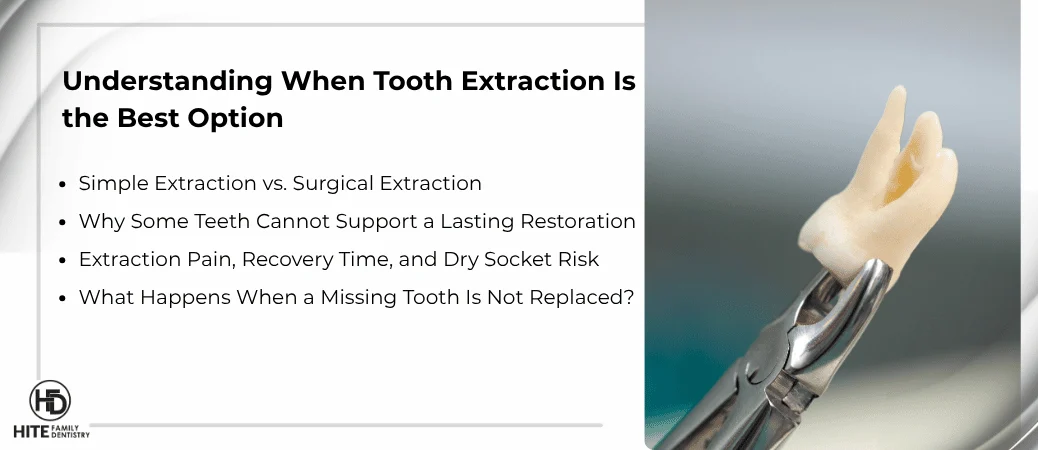
Simple Extraction vs. Surgical Extraction
A simple extraction removes a tooth that’s fully visible above the gumline, usually with local anesthesia and a quick recovery.
A surgical extraction is needed when the tooth has broken off, sits below the gum, or is impacted, similar to how wisdom teeth are often removed.
Surgical extractions involve a small incision and slightly longer healing time, but both are routine procedures your dentist performs regularly.
Why Some Teeth Cannot Support a Lasting Restoration
A tooth with too little remaining structure, an untreatable fracture, or bone loss from advanced periodontal disease often cannot hold a crown or filling reliably.
Trying to restore a tooth like this can mean the restoration fails again within months, leading to more pain and more cost.
In these situations, tooth extraction protects your oral health better than repeated attempts to save a tooth that keeps failing.
Extraction Pain, Recovery Time, and Dry Socket Risk
Extraction pain is managed with local anesthesia during the procedure and typically fades within a few days afterward. Recovery time runs from a few days for a simple extraction to a week or more for a surgical one.
Dry socket, a painful condition where the healing blood clot dislodges too early, affects a small percentage of patients and is one reason your dentist gives you specific aftercare instructions.
What Happens When a Missing Tooth Is Not Replaced?
A missing tooth that isn’t replaced can lead to shifting teeth, bite alignment problems, and gradual jawbone loss in that area.
Neighboring teeth can drift into the gap, chewing function on that side often declines, and some patients develop TMJ issues from an uneven bite.
This is why dentists nearly always discuss replacement options, including dental implants, alongside the decision to extract.
How Do Costs and Replacement Options Compare?
Comparing root canal and extraction costs only makes sense when you include what it takes to replace an extracted tooth.
A root canal on a molar runs $1,000 to $1,500, with a crown adding another $1,000 to $1,800, bringing the total for saving the tooth to roughly $2,000 to $3,300.
A simple extraction alone costs far less, but replacing that tooth changes the math considerably.
What Does a Root Canal and Crown Cost?
Root canal treatment plus a crown typically totals $1,000 to $2,500, depending on the tooth and your location. Molars generally cost more to treat than front teeth because their canal systems are more complex.
Dental insurance often covers a meaningful portion of this cost, which can narrow the gap compared to extraction plus replacement.
What Is the True Cost of Extraction and Implant Replacement?
A simple extraction costs $150 to $400, but a dental implant to replace that tooth adds $3,000 to $5,000 for the implant, abutment, and crown together.
If the jawbone has thinned, bone grafting and sinus lifts may help rebuild support before an implant can be placed.
Added together, extraction and implant replacement often costs more than saving the tooth with a root canal and crown.
| Root Canal + Crown | Extraction + Implant | |
| Typical total cost | $2,000-$3,300 | $3,150-$5,400+ |
| Recovery time | A few days | Weeks to months (with healing) |
| Preserves natural tooth | Yes | No |
| Preserves jawbone density | Yes | Requires implant to maintain |
| Additional procedures possible | Retreatment, apicoectomy | Bone graft, implant failure revision |
Should You Choose a Fixed Bridge or Partial Denture?

A fixed bridge typically costs $2,000 to $5,000 and lasts 10 to 15 years, but it requires filing down the healthy teeth next to the gap to anchor the bridge.
A partial denture costs less upfront and doesn’t require altering neighboring teeth, though many patients find it less stable when chewing.
Your dentist can walk you through restorative dentistry options based on where the missing tooth sits and how it affects your bite.
How Dental Insurance Can Affect Your Choice
Dental insurance usually covers a portion of both root canals and extractions, but implant coverage varies widely. Some plans treat implants as a major service with lower reimbursement, while others exclude them entirely.
Ask your insurance provider for exact coverage details, and talk to your dental office about how dental insurance applies to each option before deciding.
Choose the Treatment With the Best Long-Term Prognosis
Saving a tooth with a root canal is worth pursuing when the tooth has enough structure and bone support to hold up over time, especially for front teeth where appearance and bite feel matter most.
Tooth preservation protects your natural bite, keeps your jawbone healthy, and often costs less over the years than extraction followed by a dental implant.
Good oral hygiene afterward helps either option last longer, whether you keep your natural tooth or replace it.
The choice between root canal vs extraction isn’t about which treatment sounds better in general.
It’s about which one gives your specific tooth, and your specific mouth, the best chance at lasting comfort and function. Hite Family Dentistry can walk you through that evaluation and help you choose with confidence.
Frequently Asked Questions
Is it better to get a root canal or have the tooth pulled?
A root canal is often the better choice when the tooth has a good prognosis, meaning enough healthy structure and bone support to hold a crown long-term.
Extraction becomes the more responsible option when the tooth has a root fracture, severe decay, or bone loss that makes lasting repair unlikely. Your dentist can confirm which situation applies to your tooth after an exam.
Can a tooth with a cracked root be saved with a root canal?
A crack limited to the crown of the tooth can sometimes be treated with a root canal and crown.
A vertical root fracture that splits the root itself usually cannot be saved, since bacteria can enter along the fracture line no matter how well the canal is sealed. An X-ray or CBCT scan helps your dentist tell the difference.
How long does a root canal-treated tooth last with a crown?
Many root canal-treated teeth with a properly fitted crown last 10 years or longer, and a good number last a patient’s lifetime.
Longevity depends on how well the crown fits, how much natural structure remains, and how consistently you keep up with oral hygiene and checkups. Grinding habits and repeated decay can shorten that timeline.
Is an extraction cheaper than a root canal if I need an implant?
Extraction alone costs less than a root canal, but adding a dental implant usually brings the total to $3,000 to $5,000 or more, compared to $2,000 to $3,300 for a root canal and crown.
Extraction only stays cheaper if you don’t need to replace the tooth, which is uncommon for most patients. Ask your dental office for a full cost comparison before deciding.
Should I see an endodontist before agreeing to an extraction?
Seeing an endodontist before agreeing to an extraction is a reasonable step, especially if you’d prefer to keep your natural tooth.
Endodontists have advanced training and imaging tools that sometimes reveal options a general dentist doesn’t see on standard X-rays. A second opinion costs little compared to the value of confirming extraction is truly your best path.